
Choosing between bikini line and Brazilian laser hair removal comes down to one question: how much hair do you want treated?
A bikini line treatment focuses on hair that may show outside underwear or swimwear. A Brazilian treatment covers much more of the pubic area and may include the labia, perineum, and buttock strip. Neither option is inherently “better.” The right choice is the one that matches your preferred coverage, comfort level, and maintenance goals.
One important detail before you book: treatment names are not standardized. A “Brazilian” at one practice may include areas that are priced separately somewhere else. Always ask for a clear treatment map before your appointment.
| Feature | Bikini Line Laser Hair Removal | Brazilian Laser Hair Removal |
| Main treatment area | Hair visible outside typical underwear or swimwear | Most or all pubic hair, often front to back |
| Hair left in front | Usually yes | Optional: fully bare, strip, triangle, or another agreed shape |
| May include labia/perineum | Usually no | Often yes; confirm with the provider |
| Buttock strip/perianal area | Usually no | May be included; confirm before booking |
| Appointment length | Typically shorter | Typically longer because more skin is treated |
| Price per session | Usually lower | Usually higher |
| Best for | Clean swimsuit edges and less shaving along the crease | Broader, low-maintenance hair reduction |

Bikini line laser hair removal treats hair along the outer edges of the pubic area: the hair most likely to show beyond a swimsuit or underwear.
It is a focused option for people who want a cleaner outline without removing the hair on the pubic mound. Depending on the practice, the treatment may cover the upper inner thighs, the sides of the bikini line, and a small area at the top. It generally does not include the labia, perineum, or buttock strip.
Choose bikini line laser hair removal if you:
Brazilian laser hair removal treats a larger area. It commonly includes the front of the pubic region, labia, perineum, and buttock strip. Some clients choose complete hair reduction; others leave a landing strip, triangle, or another shape in front.
The exact coverage must be discussed before treatment. Do not assume that “Brazilian” always includes every intimate area or that it means completely hair-free. A reputable provider should explain exactly what will be treated and give you the option to set boundaries.
Choose Brazilian laser hair removal if you:
Full bikini is commonly used for the middle option between bikini line and Brazilian, but its definition varies widely.
In many practices, a full bikini goes farther inward than a standard bikini line and removes more hair from the top and sides. It may leave the central pubic hair intact and usually does not include the labia, perineum, or buttock strip.
Because labels are inconsistent, use plain language when you book. For example: “I want the hair outside my underwear removed, plus more from the top and sides, but I do not want the labia or buttock strip treated.” That is much clearer than relying on a package name alone.
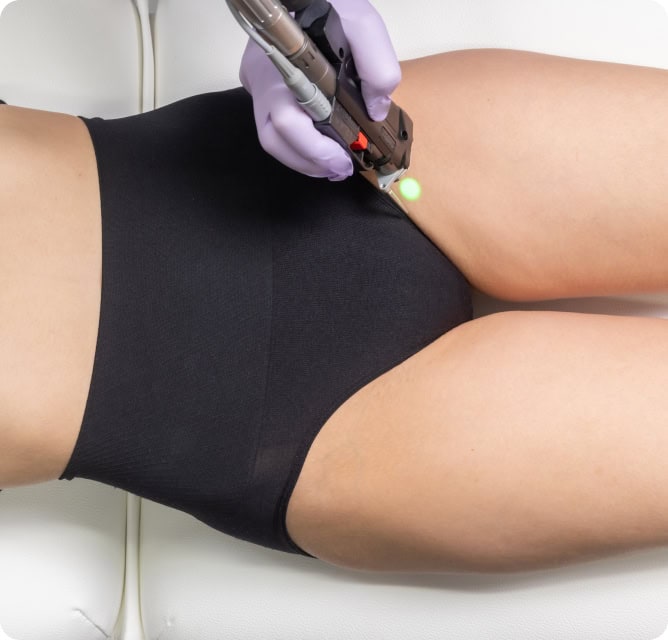
Neither treatment is more effective simply because it covers a larger area. Both use the same principle: laser energy targets pigment in the hair and heats the follicle to reduce future growth.
Results depend on factors such as:
Laser hair removal works best on darker, more pigmented hair. Blonde, gray, white, and some red hairs may respond poorly because they contain less pigment for the laser to target. People with deeper skin tones can be treated safely when an appropriate device and conservative, individualized settings are used by an experienced professional.
Laser hair removal is best described as long-term hair reduction, not a guarantee of permanent, total hair removal. Most people need a series of treatments because hair grows in cycles. Some regrowth and occasional maintenance may still occur.
It can feel more intense in certain spots because a Brazilian covers more sensitive skin. However, pain is highly individual. Hair density, treatment settings, menstrual-cycle sensitivity, skin sensitivity, and the cooling method used all affect how treatment feels.
Many people describe laser pulses as brief warmth or a quick snapping sensation. A Brazilian appointment may feel more demanding simply because it takes longer and includes more sensitive areas, not because it is automatically intolerable.
Do not rely on claims that a device makes treatment “pain-free” or guarantees that numbing cream is unnecessary. Ask your provider how comfort is managed, whether topical anesthetic is appropriate for you, and what to do if the sensation becomes too strong during treatment.
A treatment plan is individual. Many practices begin with a series of several sessions, commonly around six to eight, but that is a planning estimate rather than a promise.
Bikini line and Brazilian treatments often follow a similar schedule because the same hair-growth biology applies to both. The Brazilian area may take longer to treat, but it does not automatically require more sessions.
A good consultation should explain your projected schedule, expected response, package terms, and the possibility of maintenance appointments.

When performed appropriately, laser hair removal is generally well tolerated, but it is not risk-free. Temporary redness, warmth, swelling around follicles, and skin sensitivity can occur after treatment. Less common but more significant risks include burns, blistering, infection, scarring, and temporary or persistent pigment changes.
Tell your provider before treatment if you have:
Your provider should assess your skin and hair, review relevant health information, explain risks, and adjust or postpone treatment when appropriate. If you have a dermatologic condition, a history of significant reactions, or concerns about medication, ask your dermatologist or prescribing clinician before proceeding.
Follow the instructions from your own provider, since protocols vary by device and skin type. In general, preparation often includes:
After treatment, use gentle skin care and follow your provider’s guidance on heat, friction, exercise, sun exposure, exfoliation, and hair removal. Contact the practice promptly if you develop severe pain, blistering, spreading redness, or any reaction that feels unusual.
Choose bikini line laser hair removal if you want clean swimsuit edges, plan to keep most hair in front, or want to start with a smaller treatment area.
Choose Brazilian laser hair removal if your goal is hair reduction across most or all of the pubic area, including areas that a bikini line treatment does not cover.
Choose full bikini only after confirming exactly what the practice means by that term.
The best choice is not about what is more popular. It is about knowing the treatment boundaries before you begin, choosing a provider who can safely treat your skin type and hair characteristics, and selecting coverage that feels right for you.
No. A bikini line treatment usually addresses visible hair around the underwear or swimsuit edge. A Brazilian treats a much larger area and may include the labia, perineum, and buttock strip.
It may, but not always. Ask directly whether the perianal or buttock strip area is included in the quoted service.
Usually, yes. Tell the provider before your appointment so they can update the treatment plan, timing, consent, and price.
Laser hair removal provides long-term hair reduction. It can substantially reduce hair growth, but individual results vary and maintenance treatments may be needed.
By reducing hair growth and the need to shave or wax, laser hair removal may help reduce shaving-related ingrown hairs for some people. It is not a guaranteed treatment for every cause of bumps or irritation, so persistent or painful lesions should be evaluated by a medical professional.
Most providers ask clients to shave the planned treatment area shortly before the appointment. Do not wax or tweeze unless your provider specifically tells you otherwise, because those methods remove the hair the laser needs to target.