
Brazilian laser hair removal is a professional treatment that reduces hair growth across the pubic area, including the bikini line, labia, and between the buttocks. You can customize the treatment: remove all hair, leave a small strip or triangle, or treat only selected areas. The most important factor is not the style you choose—it is receiving treatment from a qualified provider who can select safe laser settings for your skin tone and hair type.
Unlike waxing, Brazilian laser hair removal does not pull hair out at the root during every appointment. A laser targets pigment in the hair, heating the follicle to reduce its ability to grow new hair. Results develop gradually because hair grows in cycles, so a series of sessions is necessary.
A Brazilian treatment usually covers more area than a standard bikini laser treatment.
A standard bikini laser treatment typically focuses on the hair visible outside a swimsuit or underwear line. A Brazilian laser treatment commonly includes:
Treatment boundaries vary by clinic and by personal preference. Before your first appointment, ask the provider to explain exactly what is included in the quoted service. “Brazilian” is not always defined the same way at every med spa or dermatology practice.

Brazilian laser hair removal can be a practical option for people who are tired of frequent shaving, waxing appointments, razor burn, or ingrown hairs. It is especially helpful when hair regrowth causes repeated irritation in the bikini area.
Laser hair removal works by targeting pigment in the hair shaft. Dark, coarse hair usually responds best because it contains more pigment for the laser to detect. Blonde, gray, white, and many red hairs may not respond well enough for laser treatment to be worthwhile.
Modern laser technology can treat a wider range of skin tones than older systems, but darker skin requires an experienced provider and appropriate equipment. The wrong settings can increase the risk of burns or unwanted pigment changes. The American Academy of Dermatology advises asking whether the practitioner has experience treating patients with your skin tone. American Academy of Dermatology guidance
A Brazilian laser appointment is usually straightforward, but the area is sensitive, so clear communication matters.
A Brazilian laser session often takes about 15 to 30 minutes, depending on the treatment area, hair density, and laser system.
Brazilian laser hair removal is not completely painless, but many people find it more manageable than waxing. The sensation is brief and localized, while waxing creates a stronger pulling sensation over a larger patch of skin.
Pain tolerance varies by person and by treatment area. The labia and perineal area are often more sensitive than the outer bikini line. Hormonal changes can also make the skin feel more sensitive around your menstrual period.
If you are concerned about discomfort, ask the provider whether the laser includes a cooling feature and whether a numbing product is appropriate. Do not apply a strong numbing cream on a large treatment area without professional guidance. The FDA has warned that certain high-concentration topical anesthetics may cause serious harm when misused. FDA safety warning
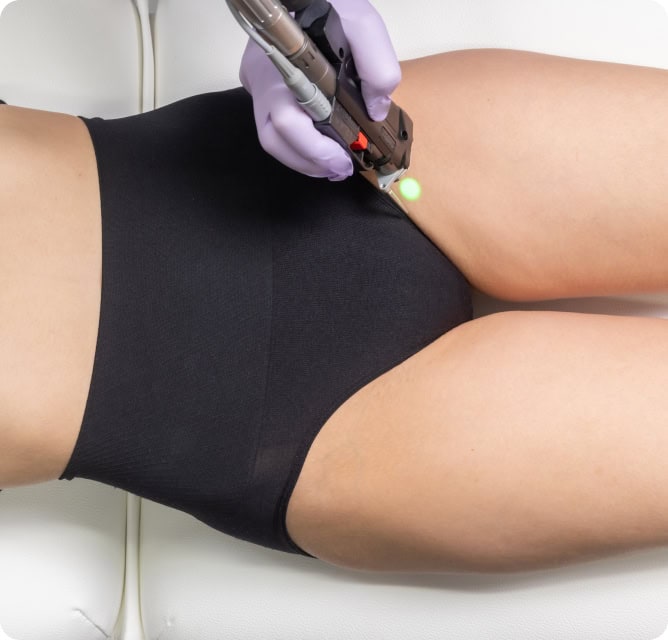
Most clients need a series of treatments because not all hairs are in the active growth phase at the same time. A common starting plan is six to eight sessions, often spaced about four to six weeks apart. Your provider may recommend a different schedule based on your hair density, skin tone, hormonal factors, and response to treatment.
After a few sessions, many people notice that regrowth becomes slower, finer, and patchier. Some people later choose occasional maintenance sessions, especially when hormones, pregnancy, PCOS, or certain medications influence hair growth.
Laser hair removal is best described as long-term hair reduction, not a guarantee that every follicle will never produce hair again.
Proper preparation improves treatment safety and gives the laser a clearer path to the follicle.
Do not feel embarrassed about the appointment. Brazilian laser hair removal is a routine service for trained providers, and a professional clinic should explain the process, maintain privacy, and make it easy to communicate your boundaries.
The skin may feel warm or look mildly red after treatment. Most people return to normal activities quickly, but the pubic area benefits from a little extra care during the first 24 to 48 hours.
Avoid:
Use a cool compress if the area feels warm, and follow the clinic’s aftercare instructions. Contact the provider promptly if you develop blistering, significant swelling, increasing pain, or signs of infection.
Brazilian waxing removes visible hair immediately, but the results usually last only a few weeks. Waxing also requires enough hair length for the wax to grip, which means allowing regrowth between appointments.
Brazilian laser hair removal requires more planning upfront, but it can reduce the need for regular hair removal over time. Between laser sessions, shaving is usually permitted, while waxing and plucking are generally avoided.
If you want immediate smoothness for a vacation next week, waxing may be the more practical short-term choice. If you want fewer ingrown hairs, less shaving, and a long-term reduction in regrowth, laser treatment may be the better investment.
At Skin Aesthetics in NYC, Brazilian laser hair removal costs $195 per session. However, the total cost depends largely on whether you pay for each visit individually or purchase a package of multiple sessions. Six to eight sessions are required to achieve permanent hair reduction.