
If you have light, gray, white, blonde, or red hair, you deserve a clear answer before paying for a laser package:
Laser hair removal is usually not a reliable option for white, gray, very light blonde, or true red hair. Dark blonde and deep auburn hair may respond in some cases, but results are less predictable than they are for dark, coarse hair.
This is not about finding a “stronger” machine or turning the settings higher. It comes down to how laser hair removal works: it needs pigment in the hair to create enough heat in the follicle.
For hair with little or no usable pigment, electrolysis is usually the more realistic long-term option.
Laser hair removal uses focused light to target melanin, the pigment that gives hair its color. When pigment in a hair absorbs that light, it converts the energy into heat. The goal is to damage the hair-growing structures enough to reduce future growth.
That mechanism creates a clear limitation:
Laser hair removal is therefore best described as long-term hair reduction, not guaranteed permanent hair removal. Multiple sessions are required because hairs grow in cycles, and even a good candidate may need occasional maintenance over time. Mayo Clinic

For fully gray or white hairs, the practical answer is no.
Gray and white hairs have very little or no melanin available to absorb laser energy. If the target pigment is missing, changing the machine, wavelength, or treatment setting does not solve the basic problem.
Be cautious if a provider promises that a “special laser” can reliably remove white or gray hair. There is no standard laser approach that makes pigment-free hair a predictable candidate for lasting reduction.
Mixed hair is different. If an area has both dark and gray hairs, laser may still reduce the darker hairs. The lighter hairs may remain.
A sensible plan can look like this:
This combination is often more efficient than trying to treat every hair with electrolysis from the start, especially on a larger body area.
“Blonde” is not one treatment category. The key question is not whether someone identifies as blonde, but whether the hairs in the specific treatment area have enough pigment and thickness.
Dark blonde or dirty blonde hair
Dark blonde hair may contain enough pigment to respond, particularly when it is coarse and visibly darker at the root. However, results are still less predictable than for brown or black hair.
A professional should assess the actual treatment area. Hair on the legs, bikini line, underarms, and face can differ dramatically in color and thickness on the same person.
Light blonde or platinum hair
Very light blonde and platinum hairs usually do not absorb enough laser energy for dependable treatment. A full package can become an expensive experiment with little visible reduction.
If the hairs are very pale, fine, or nearly translucent, electrolysis is usually the more honest recommendation.
Fine blonde “peach fuzz”
Fine vellus hair is a poor laser target regardless of whether it looks blonde, beige, or nearly clear. Treating facial peach fuzz with laser can be a poor use of money and, in some situations, may be associated with paradoxical hair growth – an increase in hair in or near the treated area.
Do not assume that every visible facial hair should be lasered. A qualified provider should distinguish coarse terminal hairs from fine vellus hairs before treating the face.
Red hair is challenging because it contains a different balance of pigment than dark brown or black hair. Many red hairs contain more pheomelanin and less eumelanin, the darker pigment laser hair removal targets more effectively.
That does not mean every red-haired person will get the same result.
The honest answer is not “yes” or “no” for every redhead. It is: do not buy a package based on a verbal promise. Ask for a test spot and evaluate the response before committing.
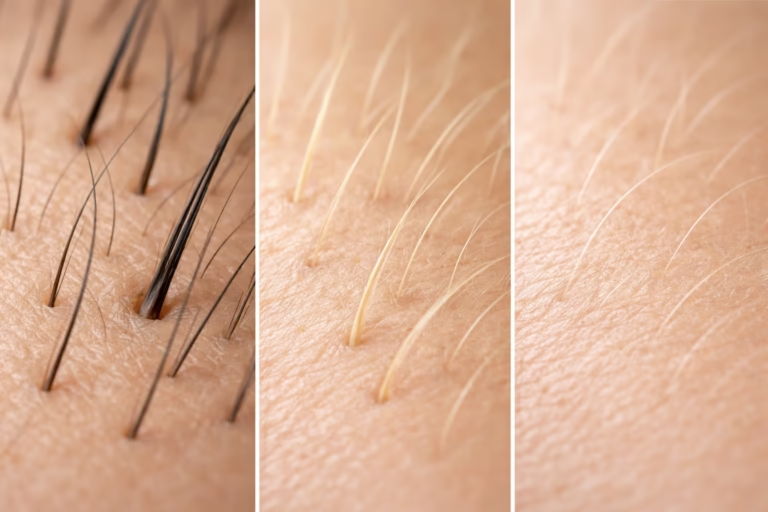
No. Coloring the visible hair shaft does not add pigment inside the follicle where laser energy needs a target.
Do not spend money on hair dye, carbon lotions, or “pigment boosters” expecting them to turn white or gray hair into a dependable laser candidate. These approaches are not established substitutes for electrolysis.
No. At-home IPL devices also rely on pigment contrast. They are generally not a dependable solution for white, gray, very light blonde, or true red hair.
In fact, at-home treatment creates an additional problem: people may keep increasing effort and spending time because the device produces warmth or a temporary cosmetic effect, without meaningful long-term reduction.
If your hair is borderline for professional laser treatment, it is even less wise to assume a lower-powered home device will solve the problem.
Electrolysis works differently from laser hair removal. Instead of relying on hair pigment, a trained electrologist treats individual follicles directly with a very fine probe and electrical energy.
That makes electrolysis suitable for:
Its downside is speed. Laser can cover a large body area quickly; electrolysis treats one follicle at a time. For that reason, electrolysis is often especially practical for facial hair, scattered hairs, small areas, and finishing work after laser has reduced darker hairs.
The U.S. Food and Drug Administration describes electrolysis as the only method approved for permanent hair removal, while laser systems are cleared for permanent hair reduction. FDA guidance on electrolysis
Not reliably on fully gray hairs because they lack the pigment laser needs. If you have mixed dark and gray hair, laser may reduce the dark hairs while electrolysis treats the gray ones.
No, not reliably. Electrolysis is generally the more appropriate option for white facial hairs.
Dark blonde, coarse hair may respond. Very light blonde, platinum, and fine blonde hairs usually respond poorly. A test spot is more useful than a generic promise.
No. Dye affects the visible shaft, not the follicular pigment laser needs to target.
Electrolysis is recognized by the FDA as permanent hair removal when follicles are effectively treated. It still requires repeated appointments because hairs grow in cycles and each follicle must be treated individually.